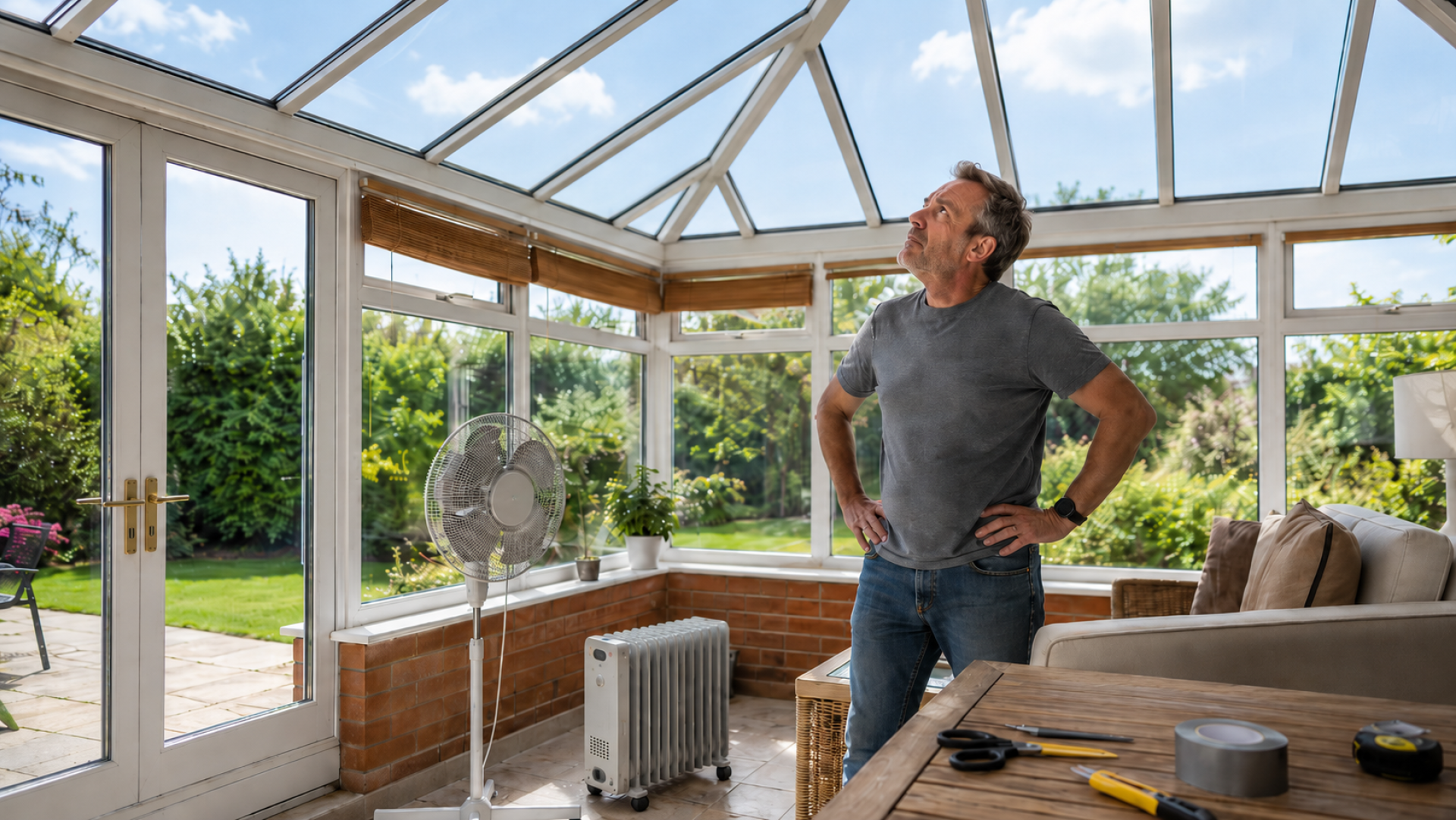
When your conservatory is too hot in summer, too cold in winter, noisy when it rains or difficult to use for most of the year, it is natural to look for a quick and affordable fix.
Many homeowners start by searching for cheap ways to fix conservatory temperature problems. Common ideas include portable heaters, fans, thermal blinds, draught excluders, reflective roof films, DIY sealants and temporary roof coverings.
Some of these can help in the short term. But they rarely solve the main problem.
If your conservatory has poor thermal performance, the issue is usually not just one draughty door, one cold window or one hot sunny day. More often, the problem is the roof and the overall structure. This means short-term DIY fixes can quickly become frustrating, expensive and ineffective.
In this guide, we look at the drawbacks of DIY conservatory fixes, the benefits of professional conservatory insulation, and why a proper roof solution can be a more cost-effective improvement in the long run.
Why do conservatories become too hot or too cold?
Many older conservatories were built to be bright, occasional-use spaces rather than fully comfortable year-round rooms.
The biggest issue is often the roof.
Traditional polycarbonate or glass conservatory roofs can allow too much heat to escape in winter and too much solar heat to build up in summer. As a result, the room can become uncomfortable at both extremes.
You may notice:
- The conservatory is too hot to sit in during summer.
- The room feels freezing in winter.
- You need fans, heaters or portable air conditioning to use it.
- Rain noise is loud and disruptive.
- Glare makes the room uncomfortable.
- Condensation appears on glazing or frames.
- The room feels separate from the rest of the home.
- You only use it for a few weeks of the year.
At that point, the question is not just ‘How do I make my conservatory warmer?’ or ‘How do I cool down my conservatory?’
The better question is:
Is the existing roof system stopping this room from being usable all year round?
Common cheap conservatory fixes homeowners try
There are plenty of temporary products and DIY ideas marketed as affordable conservatory improvements. Some can be useful, but most have limitations.
1 - Portable heaters
Portable heaters are one of the most common ways people try to make a conservatory warmer in winter.
They can provide quick heat, but only while they are switched on. Once turned off, the warmth often disappears quickly, especially if the roof is poorly insulated.
Drawbacks of portable heaters:
- They can increase electricity usage.
- They do not improve the room’s insulation.
- Heat escapes quickly through the roof.
- They can make the room feel patchy rather than evenly warm.
- They do nothing to solve summer overheating.
A heater treats the symptom. It does not fix the cause.
2 - Fans and portable air conditioning
In summer, many homeowners use fans to make the conservatory feel more comfortable.
Fans can move air around, but they do not remove the underlying heat gain caused by direct sunlight and poor roof performance. Portable air conditioning may cool the room temporarily, but it can be expensive to run and may still struggle if the conservatory roof is constantly allowing heat to build up.
Drawbacks of fans and portable air conditioning:
- Fans circulate warm air rather than removing heat.
- Portable air conditioning can be costly to run.
- Equipment takes up space.
- Noise can make the room less relaxing.
- The room may still overheat in direct sun.
Again, the problem is not always a lack of cooling. It is often that the room is gaining too much heat in the first place.
3 - Thermal blinds
Thermal blinds are a popular conservatory upgrade because they can improve privacy, reduce glare and help with heat control.
They can be useful, especially for windows. However, roof blinds can be expensive, difficult to maintain and may not fully solve the problem if the roof itself is still performing poorly.
Drawbacks of thermal blinds:
- They can be costly, especially for large conservatories.
- Roof blinds can collect dust and condensation.
- They reduce natural light when closed.
- They may not prevent major heat loss or heat gain.
- They do not repair an ageing or inefficient roof.
Blinds can help manage comfort, but they are not the same as properly insulating or upgrading the roof.
4 - Reflective films and DIY roof coverings
Some homeowners use reflective films or DIY roof coverings to reduce glare and summer heat.
These may offer a temporary improvement, but they can also affect the appearance of the conservatory, reduce light and risk looking untidy over time. Poor installation can also cause bubbling, peeling or uneven results.
Drawbacks of reflective films and coverings:
- Results can look patchy or temporary.
- Films may peel or discolour.
- They can reduce the bright, open feel of the room.
- They do not create a complete insulated roof system.
- They may not be suitable for every conservatory roof type.
A temporary covering may make the room slightly more comfortable, but it will not usually create a properly finished living space.
5 - DIY sealants and patch repairs
If a conservatory leaks, many people try to seal the affected area themselves.
This can sometimes help with a very minor issue, but leaks are often more complicated than they first appear. Water may enter in one place and show up somewhere else. A visible drip may be caused by failed seals, damaged roof panels, movement, poor flashing or ageing roof components.
Drawbacks of DIY leak repairs:
- The visible leak may not be the source of the problem.
- Incorrect sealant can fail quickly.
- Water damage may continue unseen.
- Temporary repairs can delay proper investigation.
- Repeated patching can become expensive over time.
If your conservatory roof leaks repeatedly, a permanent solution is usually better than another short-term repair.
Temporary fixes vs permanent conservatory improvements
The main issue with many cheap conservatory fixes is that they only work while you are actively using them.
A heater only helps when it is switched on. A fan only helps while it is running. A temporary sealant only helps until it fails again. A roof film only manages one part of the problem.
Proper conservatory insulation or a professional roof upgrade is different because it is designed to improve the performance of the space itself.
That means your conservatory can become:
- Warmer in winter.
- Cooler in summer.
- Quieter when it rains.
- More comfortable for everyday use.
- More energy-efficient.
- More like a proper room.
- Easier to furnish and enjoy.
- More useful all year round.
This is the difference between managing a problem and solving it.
Is DIY conservatory renovation worth it?
Some DIY conservatory improvements are absolutely worthwhile.
Cleaning the frames, clearing gutters, checking seals, refreshing furniture and improving ventilation are all sensible maintenance tasks. Painting, decorating and styling the space can also make a big difference to how it feels.
But when it comes to temperature control, roof performance, insulation, leaks and structural comfort, DIY has clear limits.
A conservatory roof is a specialist part of the home. It needs to manage weather, heat, ventilation, water drainage, thermal performance and internal finish. A poor DIY approach can create further issues, especially if it affects ventilation, traps moisture or adds unsuitable weight to the existing roof structure.
Before attempting a major DIY conservatory renovation, consider:
- Will this solve the cause of the problem or just hide it?
- Could it affect ventilation or condensation?
- Is the material suitable for a conservatory roof?
- Will it add unnecessary weight?
- Will it still look good in 12 months?
- Could it affect future professional work?
- Is it really cheaper once time, tools and repeat repairs are included?
A cheap fix is only good value if it works properly and lasts.
The hidden cost of cheap conservatory fixes
Cheap fixes often seem attractive because the upfront cost is lower. But the long-term cost can add up quickly.
For example, you may buy a portable heater in winter, then fans in summer, then blinds to manage glare, then sealant to fix a leak, then another product to deal with condensation, then redecorate because damp or temperature changes have affected the interior.
Over time, you can spend a significant amount without ever making the room properly usable.
The hidden costs can include:
- Higher energy usage.
- Repeated product purchases.
- Temporary repairs that need redoing.
- Reduced use of the room.
- Damage to furniture or flooring.
- Ongoing frustration.
- Lost opportunity to create a proper living space.
A professional conservatory roof solution may involve a bigger initial investment, but it can be more cost-effective when it creates a room that works properly throughout the year.
Benefits of professional conservatory insulation
Professional conservatory insulation is designed to address the performance of the room, not just one symptom.
The benefits can include:
- Better year-round temperature control.
- A warmer conservatory in winter.
- A cooler conservatory in summer.
- Reduced glare.
- Lower rain noise.
- A more comfortable living space.
- A more modern internal finish.
- Less reliance on temporary heaters and fans.
- Improved usability of the room.
- A more long-lasting home improvement.
For many homeowners, the biggest benefit is simple: they finally start using the conservatory again.
Instead of a room that is avoided in hot, cold or wet weather, it can become a dining area, reading room, home office, playroom, hobby room or everyday extension of the home.
Why the roof matters most
When homeowners think about improving a conservatory, they often start with furniture, blinds, flooring or décor.
Those things matter, but the roof has the biggest impact on comfort.
A poorly performing roof can make even the most beautifully decorated conservatory uncomfortable. It can make the room too hot, too cold, too bright, too noisy or too difficult to use.
A better roof system can transform the experience of the space.
At CI Group, our roof systems include SkyTherm, ThermaTile and the CHRIS System, giving homeowners professional options for improving conservatory comfort, appearance and year-round usability.
These systems are designed to help turn an underused conservatory into a more practical, comfortable and valuable part of the home.
When should you stop using temporary fixes?
Temporary fixes can be useful in the short term, but they should not become the long-term plan.
It may be time to consider a professional solution if:
- Your conservatory is still too hot in summer.
- It is still too cold in winter.
- You rely on heaters, fans or portable cooling.
- The roof leaks more than once.
- Rain noise makes the room unpleasant.
- Condensation or mould keeps returning.
- DIY repairs are not lasting.
- You avoid using the room for much of the year.
- You want the conservatory to feel like a proper living space.
The more often a problem returns, the less likely it is that another cheap fix will solve it.
Cheap fix or proper insulation: which is better value?
The best option depends on the problem.
If your conservatory simply needs cleaning, minor maintenance or better styling, then affordable DIY improvements may be enough.
But if the room is uncomfortable, inefficient, leaking or difficult to use year-round, proper insulation or a professional roof upgrade is usually the better long-term route.
Here is a simple way to think about it:
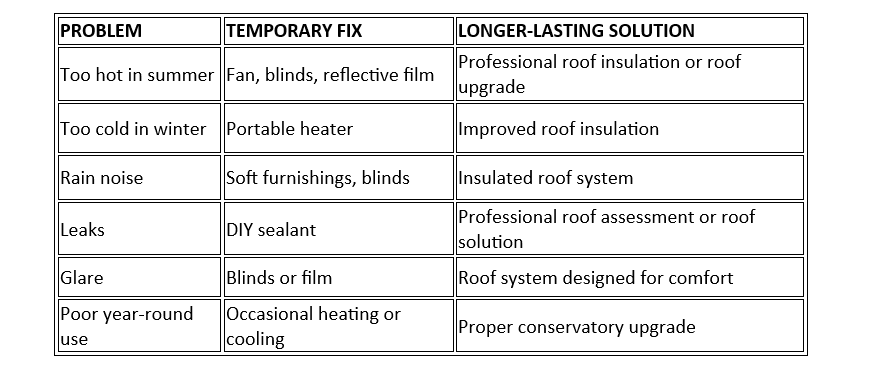
A temporary fix may be cheaper today. A proper solution may be better value over time.
Can you renovate a conservatory yourself?
Yes, you can make many cosmetic and maintenance improvements yourself.
For example, you can:
- Clean the frames and glazing.
- Clear gutters.
- Improve ventilation.
- Update furniture.
- Add rugs and soft furnishings.
- Repaint suitable surfaces.
- Add plants and lighting.
- Refresh the layout.
But for insulation, roof performance, leaks and long-term temperature control, it is better to get expert advice.
Professional installation ensures the right materials, finish and approach are used for your conservatory. It also helps avoid the risks of unsuitable DIY methods, such as trapping moisture, adding unnecessary weight or creating a finish that does not last.
Make your conservatory warmer in winter and cooler in summer
A conservatory should not be a room that only works for a few weeks of the year.
If you are constantly trying to heat it, cool it, patch it or avoid using it, the issue is probably not your furniture, your blinds or your choice of fan. It is likely the performance of the room itself.
Professional conservatory insulation can help create a more stable, comfortable environment. That means you can enjoy the space in more seasons, for more purposes and with less reliance on temporary fixes.
Whether you want a calm morning room, a family dining space, a home office or simply somewhere to enjoy the garden from indoors, improving the roof can make the biggest difference.
Speak to CI Group about a proper conservatory solution
Cheap conservatory fixes can seem appealing, but they often only delay the real decision.
If your conservatory is too hot, too cold, leaking, noisy or difficult to use, a professional roof solution could be the more cost-effective and long-lasting improvement.
At CI Group, we help homeowners upgrade underused conservatories with expert roof systems including SkyTherm, ThermaTile and the CHRIS System.
Our solutions are designed to improve comfort, reduce common conservatory problems and help you enjoy your space all year round.
Book your free conservatory roof quote today and find out how to make your conservatory warmer in winter, cooler in summer and usable in every season.